
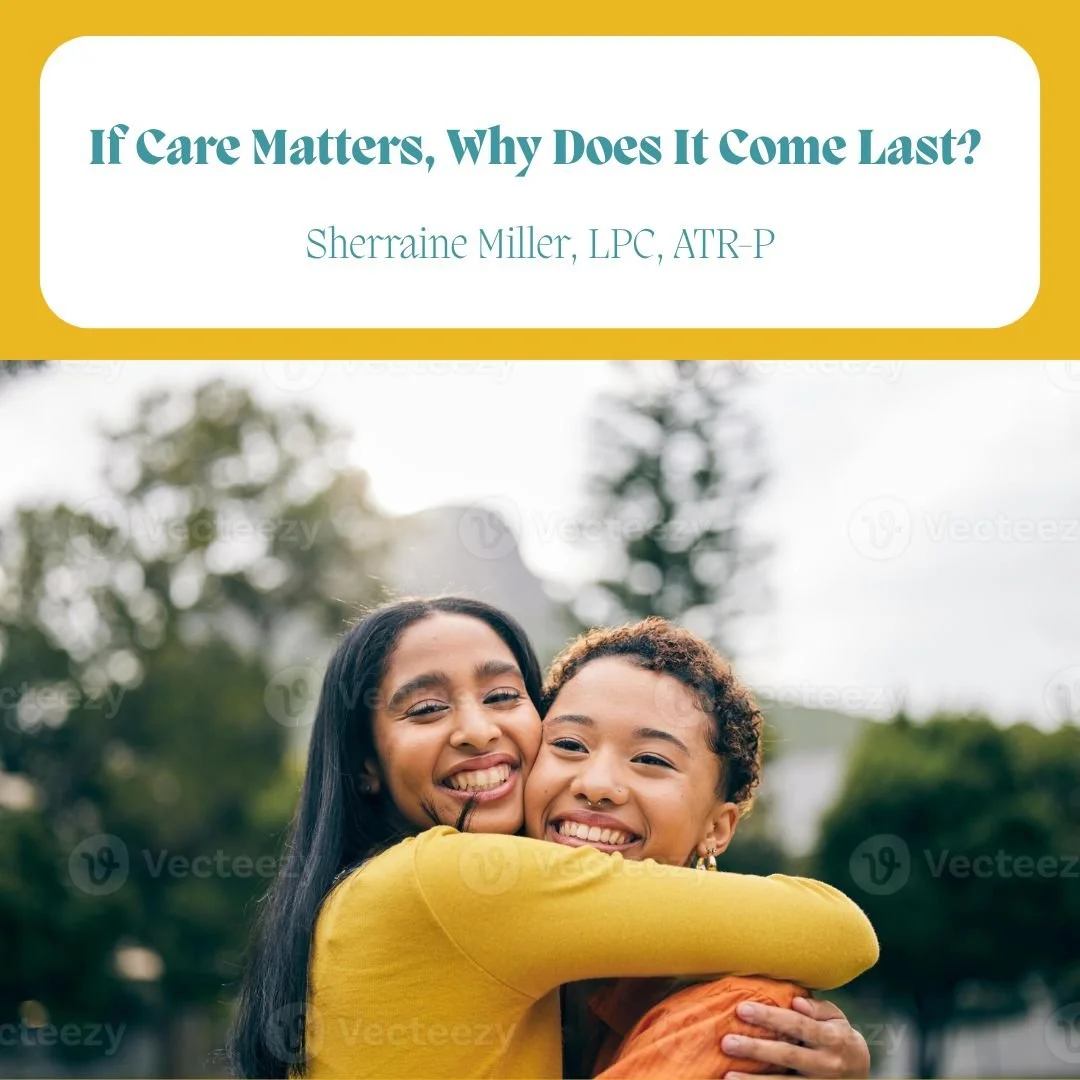
If Care Matters, Why Does It Come Last?
Recently, I attended “Self-Care Social” where founder, Latoya Shanell, describes the event as a space for people to "slow down, to feel, to reconnect, and to be supported without pressure."
After spending the day immersed in conversations about burnout, caregiving, rest, and the mental load so many of us carry, I realized I wasn't only leaving with new tips, wellness practices, and self-care goodies. I was leaving with a feeling of being held simply through small moments of connection. Brief shared moments and conversations that lasted five or ten minutes or so, yet felt like a breath of fresh air. The kind of connection that, in Latoya Shanell's words, "mattered in a deeper way.”
As I reflected, I realized that those moments of connection really felt like care.
In a culture that often rewards having the answers, pushing through, and holding everything together, there was something refreshing about entering a space built around a different message we rarely get around care: you can show up exactly as you are. When you’re able to show up pressure free, it releases a level of functioning many of us are operating in on a daily basis. It makes it easier to reconnect with, and choose, the self. That sense of care has stayed with me long after the event ended, and I’ve found myself wondering more and more about care.
The Power of Connection
“Self-Care Social” included many thoughtful panel discussions, wellness activations, vendors, opportunities to connect, and a plethora of conversations about what it truly means to care for ourselves in a world that consistently asks us to keep pushing.
Several memorable discussions throughout the day centered on the mental load many people carry and the challenge of slowing down. Panelists spoke honestly about the discomfort that can come with stillness and the ways our culture rewards productivity, busyness, and over-functioning. The message wasn't simply "rest more." It was an invitation to examine our relationship with rest altogether. A rest that may ask you to sit still more throughout any given day, not just at their ends.
Walking through the event, I found myself being drawn to a bit of everything, but mostly to the people and the conversations happening in each room. The conversations felt very open, honest, and grounded. People spoke openly about feeling stretched thin, struggling to slow down, and trying to find ways to care for themselves without guilt. It really felt like we were all eager to learn, but also even more willing to share.
You Don’t Need Permission
As a therapist, one thing stood out to me: the event felt like a collective untangling of needing permission to receive care. A care that started right at the beginning by encouraging the community to come as they are, connect with others, or simply relax.
So many of the conversations centered around themes that I hear regularly in the therapy room. How do I slow down? How do I rest without feeling guilty? How do I communicate my needs? How do I stop over-functioning? How do I make space for myself when everyone seems to need something from me? How do I make the time I know that I really need?
Most of us know that we need rest. We know we need boundaries. We know we need support. The challenge is rarely a lack of awareness, but feeling allowed to prioritize the things that make us feel like us. And while we love a good self care routine, for some reason or another, it’s not getting done. So perhaps what we’re searching for is permission.
Permission to pause.
Permission to be tired.
Permission to stop carrying everything alone.
Permission to acknowledge that high functioning is not the same thing as being well.
But most importantly and ironically, permitting ourselves to stop searching for permission. To remember that stillness should not come last.
So comes the question: If care matters so much, why does it so often come last? Why are so many of us waiting until the end of the day to finally sit still?
Why Care Comes Last
Six o’clock came, and while the event was wrapping up, and microphones were being packed away, panelists continued to share their experiences in motherhood. One thing that’s certain is that we all agree that caregiving matters. We know that many people—particularly mothers—carry enormous emotional, physical, logistical, and mental loads every day. So this moment felt symbolic for me too, because we recognize that care work is important.
And yet, how often does care end up at the end? After the work is finished, and the responsibilities are handled. After other’s needs have been addressed. After there is little energy left. The moment felt reflective of many people’s experience in their daily lives. Caregiving is essential, yet caregivers are often expected to fit themselves in around everything else.
Creating Space for Care
Maybe that’s why conversations about rest, burnout, mental loads, peace, and self-care resonated so deeply throughout the event. Many people are not simply looking for ways to recharge. They are looking for ways to reclaim space for themselves in lives that constantly ask for more. For a way to gain clarity and honor their energy.
Throughout the day, there were many opportunities to meet with entrepreneurs, wellness professionals, and community members who had built businesses, services, and spaces centered around care. I heard stories about the invisible loads they carried, and the intentional choices they made to care for themselves along the way by choosing it whenever and however it was needed. Their stories also served as a reminder that choosing care is often not a single decision, but an ongoing practice.
As a Black woman, it was beautiful to witness many women, particularly women of color, creating, leading, educating, and building. Not because the event was exclusively for one community, but because representation matters. There is something powerful about being reminded that people who look like you can create meaningful things, bring people together, and build spaces that didn't exist before.
Self-Care Social
I left feeling extremely inspired beyond the conversations. I was inspired by others being willing to create environments where those conversations could happen, where care could be cultivated collectively, and where I could choose stillness without pressure.
Self care can be so many things. A massage, a quiet moment, a walk, or a favorite hobby. But it can also be a room full of people talking honestly about what it means to be human. It can be a community willing to acknowledge exhaustion rather than glorify it. It can be a space that reminds us that rest is not something we have to earn.
For me, the most powerful thing about the event was not any single wellness practice or takeaway. “Self-Care Social” served as a reminder that when we intentionally create spaces where care is centered first, we make it easier for one another to choose care too, while canceling the idea that care was ever something we needed permission to access in the first place.