

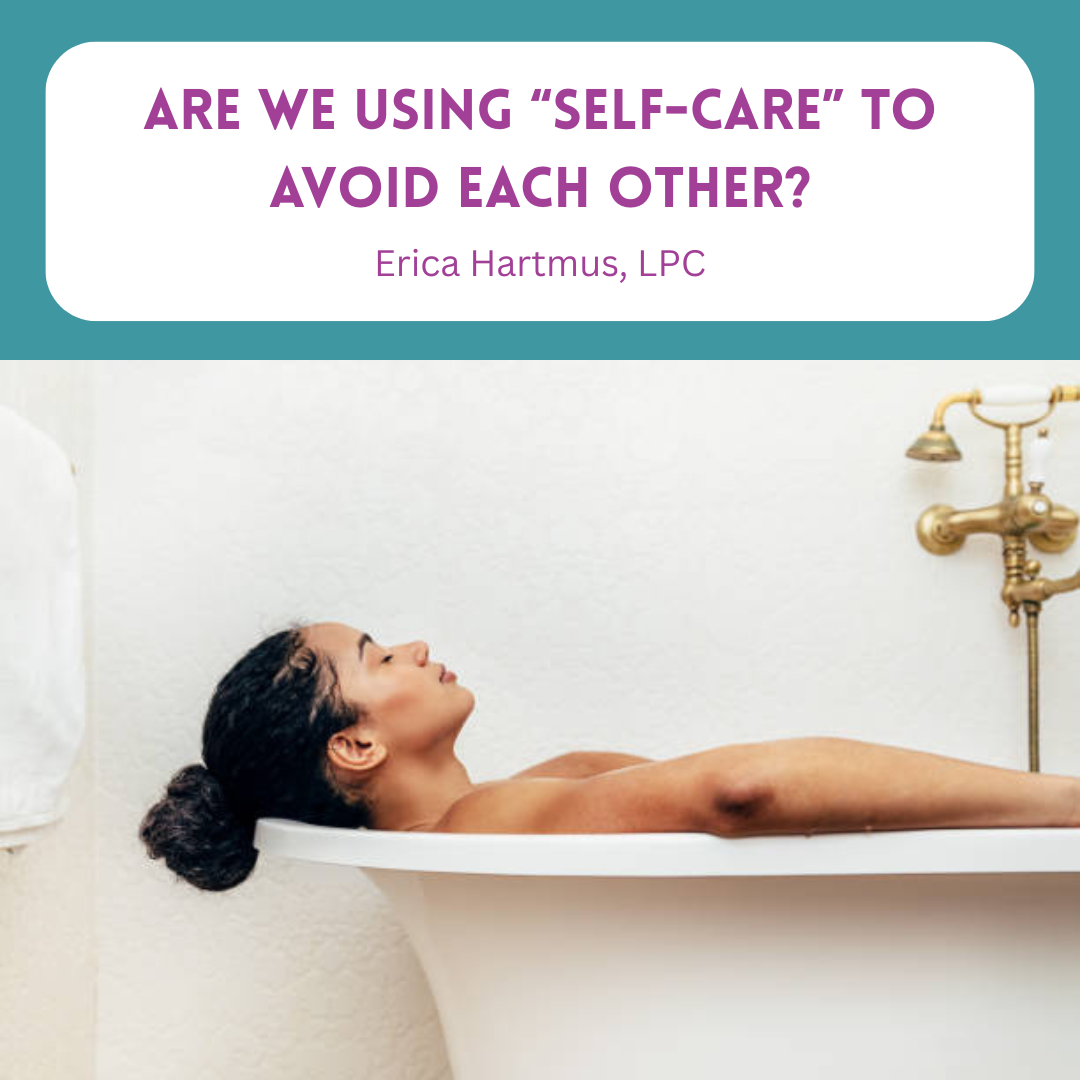
I recently attended Self-Care Social in Chicago, a wellness-focused event centered around restoration, mindfulness, and community care, that provided me with so many wonderful insights, but also caused me to reflect on society’s current trends around self-care today. Like any other concept-turned-corporate business model, the self-care industry certainly contains multitudes. As a therapist, I preach self-care day in and day out to my clients. Living in America means working like a dog, and often having little relaxation to show for it. We work to make money, then we’re exhausted by the work, then we spend said money on vacations and nice dinners and treating ourselves…all examples of self-care in my book.
What Self-Care Used to Mean to Me
For me, self-care has always meant practicing free-will for free-will’s sake. Reminding yourself that life is actually meant to be enjoyed, not just completed. Resting in a bubble bath, laughing with friends, eating something indulgent. I champion leaving work early once in a while, buying those plane tickets, and making exciting choices not because they’re going to further us in our aspirations or goals, but because we CAN. I genuinely believe pleasure, softness, and rest are the best parts of being human.
When Self-Care Starts Prioritizing the Self Above All Else
Here’s where I got stuck at the event. Many of the speakers in the panel spoke about self-care from a business owner’s perspective. They spoke from a place of abundance and self-motivation, and many things I heard were quite inspiring. However, I noticed a theme that I’ve been seeing a lot lately in other self-care content. Many of them championed saying no whenever possible, being okay with disappointing people, and putting yourself first even if it upsets someone you care about. With the rise of this rhetoric (which sounds eerily similar to the “grindset” mentality in my opinion) self-care evolved from “how do I take care of myself?” into “what relationships can I put less of myself into?”
This mindset might work for the success-driven individual. If your goal in life is to reach your fullest potential in your career, your fitness, or your finances, then prioritizing the self is the way to do it. But for many of us, our relationships with others add a layer of responsibility that isn’t just about self. To connect with others means inherently to sacrifice parts of ourselves. Our time, our emotional energy, our vulnerability, all become currency in exchange for connection with others.
The Discomfort Required for Real Connection
That’s not to say we should engage in relationships that are exhausting and overly time-consuming, or relationships that leave us feeling more empty than we felt alone. But we do need to examine the line. To combat the all-or-nothing narrative around self-care that I’ve seen recently, it’s important to note that it’s not always a good idea to prioritize your comfort over everyone else's. At least, not if you genuinely care about the people you’re interacting with.
Connection requires things that don’t always feel comfortable or convenient. There are many examples of this. In order to connect, we need to practice patience, which can be emotionally draining. Accountability, which can be uncomfortable. Compromise, which might mean putting your wants or needs second to someone else’s. Inconvenience, to show up for someone else when needed, even if you don’t want to.
You might be thinking “I know how to be a good friend. This stuff is obvious.” But the thing that becomes tricky is remembering these lessons when the following narratives are so prevalent in self-care marketing:
“Protect your peace.”
“Don’t be afraid to say no to people.”
“You don’t owe anyone anything.”
Some relationships will impact the speed of which you reach your goals. It might be a longer road to success when you’re taking detours to prioritize relationships. The key is balance. If your energy truly needs to be dedicated 100% to your grind, that’s valid. Sometimes, we literally can’t afford to put people ahead of ourselves. But it’s also true that if you start to consistently say no to other’s requests for help, you can’t expect them to be there for you when you need it. If you protect your peace too often, people will stop inviting you. And if you truly don’t believe you owe anyone anything, then you can’t expect to connect.
What We Risk Losing
If we listen too closely to these themes of today’s self-care content, we risk losing our tolerance for the ordinary discomfort of being close to other humans. We might forget that closeness requires being inconvenienced sometimes. We might cut people off prematurely at the first sign of disappointment. We might lose our capacity to empathize with the struggle that is life.
If we prioritize control of self over everything else, we might feel safer knowing that our emotions will always be exactly as we want them to be. We’ll find that we have a better gauge of how much we need to work in order to get the results that we want. We’ll know that our down-time can consist of sit-coms that won’t argue with us, or bubble baths that won’t ask for a ride to the airport. When we’re faced with overstimulation and stress, solitude feels calming. But as people, we need to learn that sometimes, the support of others becomes the thing we need most in order to heal.
Why Human Connection Still Matters
Regardless of how individualized the self-care industry has become, our biology still has a high requirement for the company of others. We regulate our emotions through safe connection, a hug from a friend, or a soothing voice telling us it’s okay to cry. And sometimes self-care does genuinely look like canceling plans and staying home. But it might also look like going to that dinner, even though you don’t feel like it, even though you’ll have to work later tomorrow, because you know your friends will make you laugh while you’re there.
Boundaries vs. Avoidance
The event I attended also contained so many messages around self-care that I absolutely bought into. There were countless themes around physical wellness, getting the rest you need, and taking breaks. But I couldn’t help but address how often these specific “put yourself first, always” self-care messages are actually preaching avoidance. Avoiding difficult conversations, uncertainty, complex dynamics. To me, it all sounds like we’re really only avoiding one thing: needing other people.
Can We Have Both Success and Connection?
When you’re pushing for a certain level of success, isolation can feel incredibly safe. It can be the only way to ensure that your time is completely utilized in the pursuit of one thing. For people starting from nothing, that level of commitment and control can feel like life-or-death. But eventually, many people find themselves deeply lonely while technically doing everything “right” from a business perspective. Therefore, I can’t help but wonder when these messages become too black-or-white. Can’t we have it all? Connection, love, friendship, success, financial security, abundance? Can we forgo “say no” and instead preach “ask for support”?