

In recent years, researchers, psychologists, sociologists, and philosophers have all come to the same conclusion: we are lonely. “The loneliness epidemic” is a crisis marked by increasing social isolation and lack of meaningful connection to others. It is so endemic that in 2023, the U.S. Surgeon General declared loneliness a public health concern, estimated to affect around fifty percent of adults in America.
Loneliness is often illustrated as a solitary experience, one in which we stay inside and seclude ourselves. While this existence can most certainly be full of loneliness, there is also the loneliness that exists within a crowded room. A loneliness in which we feel unseen, unheard, and alone. Loneliness is defined as the feeling of being disconnected, misunderstood, or unwanted. How many people wander through life, existing in crowded rooms, known by many, and yet feel completely alone amongst it all? The irony of loneliness is that it is probably most pointedly felt in these exact scenarios. When we are surrounded by the opportunity for connection, for depth, and yet, we can’t reach it. Norman Cousins once wrote, “The eternal quest of the individual human is to shatter his loneliness.”
Why Connection Is More Than Being Around People
If loneliness is comprised of feeling disconnected and feeling misunderstood, then the solution appears relatively simple: develop more meaningful, connected relationships with others. And yet, loneliness persists. Why do we struggle to connect with others and create meaningful, sustainable relationships? Is loneliness truly as simple as making more friends? Firstly, there is a major difference between interacting with other humans versus connecting with another person. Most individuals can sustain small-talk, or a relatively simple conversation with another human. What many more struggle with is the feeling of being truly seen, understood, and loved by another person: connecting. We can also struggle to provide that presence and connection to others in our own life. There is a level of vulnerability in deep connection that is not only difficult to unearth, but takes time and energy to sustain, and can be deeply uncomfortable to exist in.
The Different Types of Loneliness
Secondly, there is more than one type of loneliness. A lack of meaningful connection to other people is known as “interpersonal loneliness”: the feeling of estrangement between persons. However, we can also feel deeply estranged from ourselves, which is known as “intrapersonal loneliness”. This is the sense of emptiness that arises when we feel disconnected from ourselves. Intrapersonal loneliness not only means that we struggle to connect with ourselves, but it continues to estrange us from others as well. How can we meaningfully connect to other people if we do not know the self who is doing the connecting?
Why Loneliness Is Part of Being Human
Thirdly, there is a deeply complex and uncomfortable reality about loneliness, and its inevitability. We will all experience loneliness in our lives, to varying degrees. Beyond interpersonal and intrapersonal loneliness, there is existential loneliness. Existential loneliness asks us to confront the fact that we all exist in this world as individuals. We are alone in our experience and perspective and unless another person can become you, it is impossible for another individual to completely understand your unique, personalized way of experiencing the world.
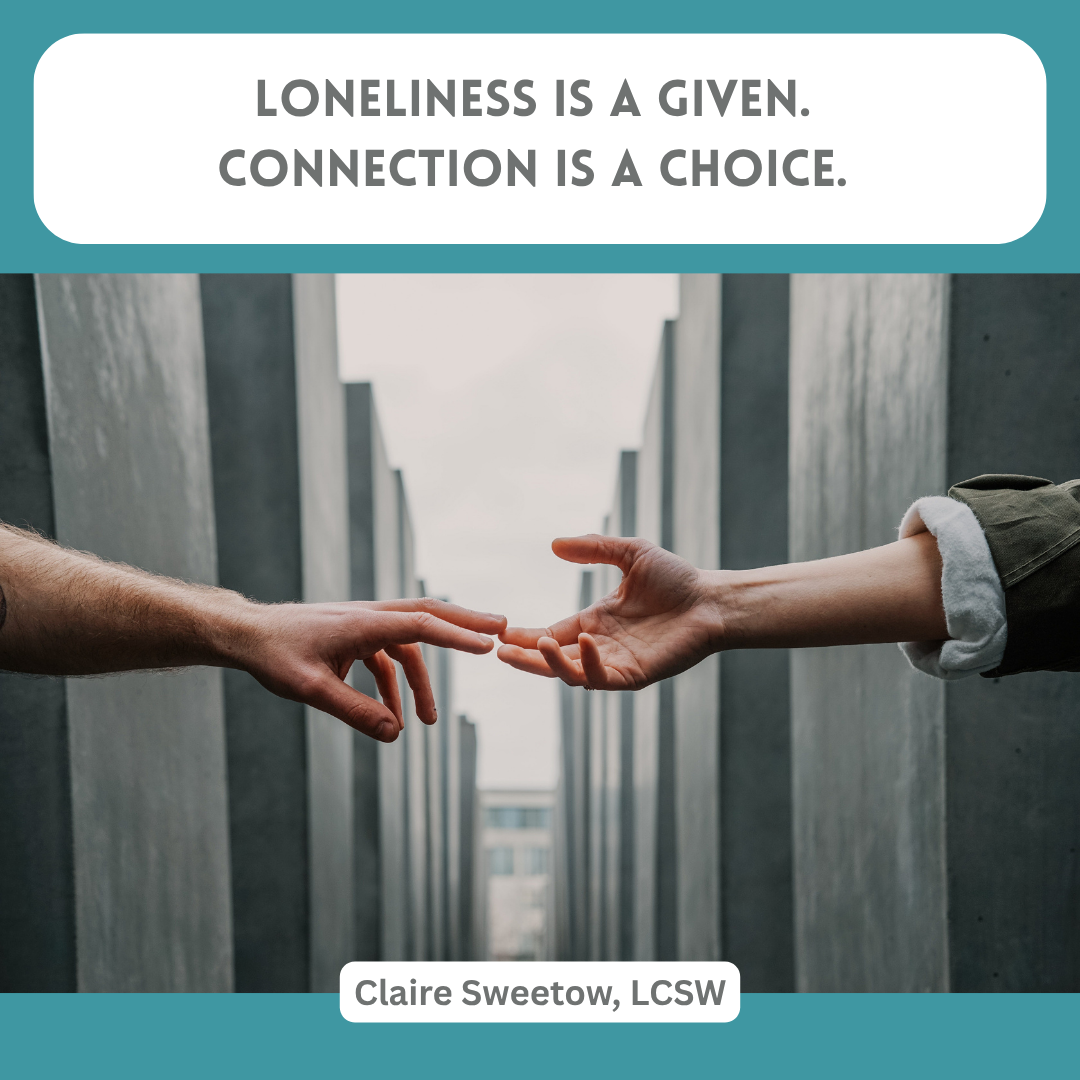
Psychiatrist and psychotherapist Irvin Yalom refers to loneliness as a “given” of life. We enter life alone and we depart it alone. There is therefore an “unbridgeable gap” between ourselves and others. We struggle with this fact, and often despair in the face of it. In an attempt to cope, we cling to unhealthy social connections, lose ourselves in group identity, seek refuge in distractions, and sometimes write-off social connection altogether. Yet Yalom believes that true intimacy is the willingness to reach out our hands across this gap and attempt connection regardless. As Yalom says in his book, When Nietzche Wept, "Isolation only exists in isolation; once shared, it evaporates."
How do you experience loneliness? Is it a lack of meaningful connection with others? Do you feel a sense of disconnect from yourself? Or perhaps you feel alone in life, sensing the unbridgeable gap? Perhaps the answer to loneliness is not in escaping it altogether, but rather in the knowledge that it is natural and inevitable, and that despite it, we can be brave enough to attempt meaningful connection in the face of it. We can reach out to others, we can reach into ourselves, and we can reach out for something bigger than ourselves. It may never be perfect, it may never be whole, but it is worthwhile nonetheless. Choose connection.